Wildfire Safety Newsletter
Preparing for Wildfires
Wildfires can happen quickly, making preparation essential for every household and business. From protecting your home and loved ones to planning for pets and livestock, small actions taken today can make a big difference during an emergency. The Community Risk Reduction Team has created an e-newsletter with valuable information, resources, and simple steps you can start with today to help reduce wildfire risk and keep your community prepared.

This newsletter will cover:
- Emergency Alerting systems
- Home Ignition Zone and Home Hardening
- Low Flammability Landscape Plants
- Colorado Wildfire Resiliency Code
- South Metro Community Risk Reduction Team and Additional Resources
EMERGENCY ALERTS

Stay informed and get notified of when and where an emergency is happening. Emergency alerts are designed to keep you safe and informed during critical situations, including: Natural Disasters (wildfires, floods, severe storms), Evacuations, Shelter-in-Place Orders, Missing Persons, and others.
SIGN UP FOR YOUR COUNTY'S EMERGENCY ALERT SYSTEM HERE
Learn about Wildfires in Colorado

Just under half of all Coloradans live in the wildland-urban interface (WUI) and are at risk from wildfires.
The Wildland-Urban Interface is the area where homes meet or intermingle with undeveloped land. These areas face a higher risk of wildland fires. Knowing your risk will help you prioritize your wildfire mitigation plans.
THE HOME IGNITION ZONE AND HOME HARDENING
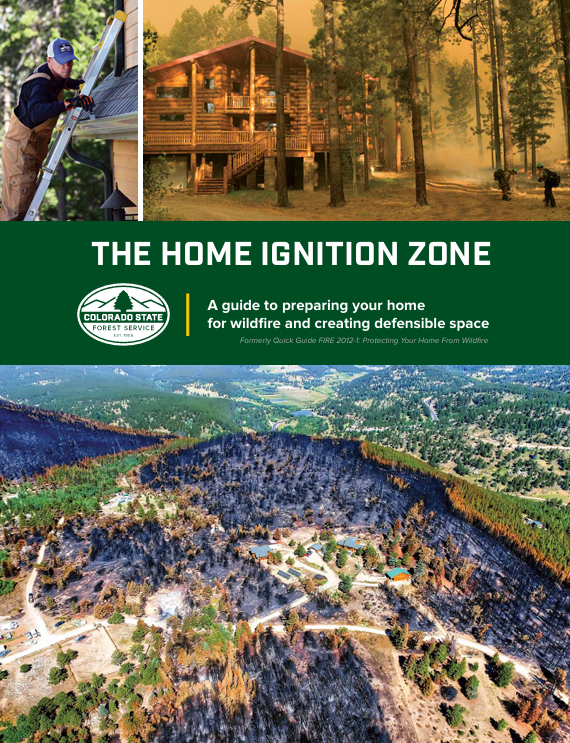
We tend to be more afraid of the large trees or brush at the edge of our property or even our neighbor's property, but research shows mitigating risks in the immediate area around your home makes the biggest difference in protecting your home against wildfires.
"The two primary determinants of a home’s ability to survive a wildfire are the structure’s ignitability and the quality of the surrounding defensible space. Together, these two factors create a concept called the home ignition zone, which includes the structure and the area around it." - Colorado State Forest Service
* The following information is directly from the Colorado State Forest Service's Home Ignition Zone Guide.
What is Defensible Space?
Defensible Space the area around a home (or structure) that has been modified to reduce fire hazard by creating space between potential fuel sources. This is done by creating a disconnected fuel load both vertically and horizontally. Establishing defensible space reduces the likelihood of a home igniting by direct flame contact or radiant heat exposure. It also helps limit the local production of embers and reduces the chance a structure fire will spread to neighborhing homes or surrounding vegetation.
How do I create an effective defensible space?
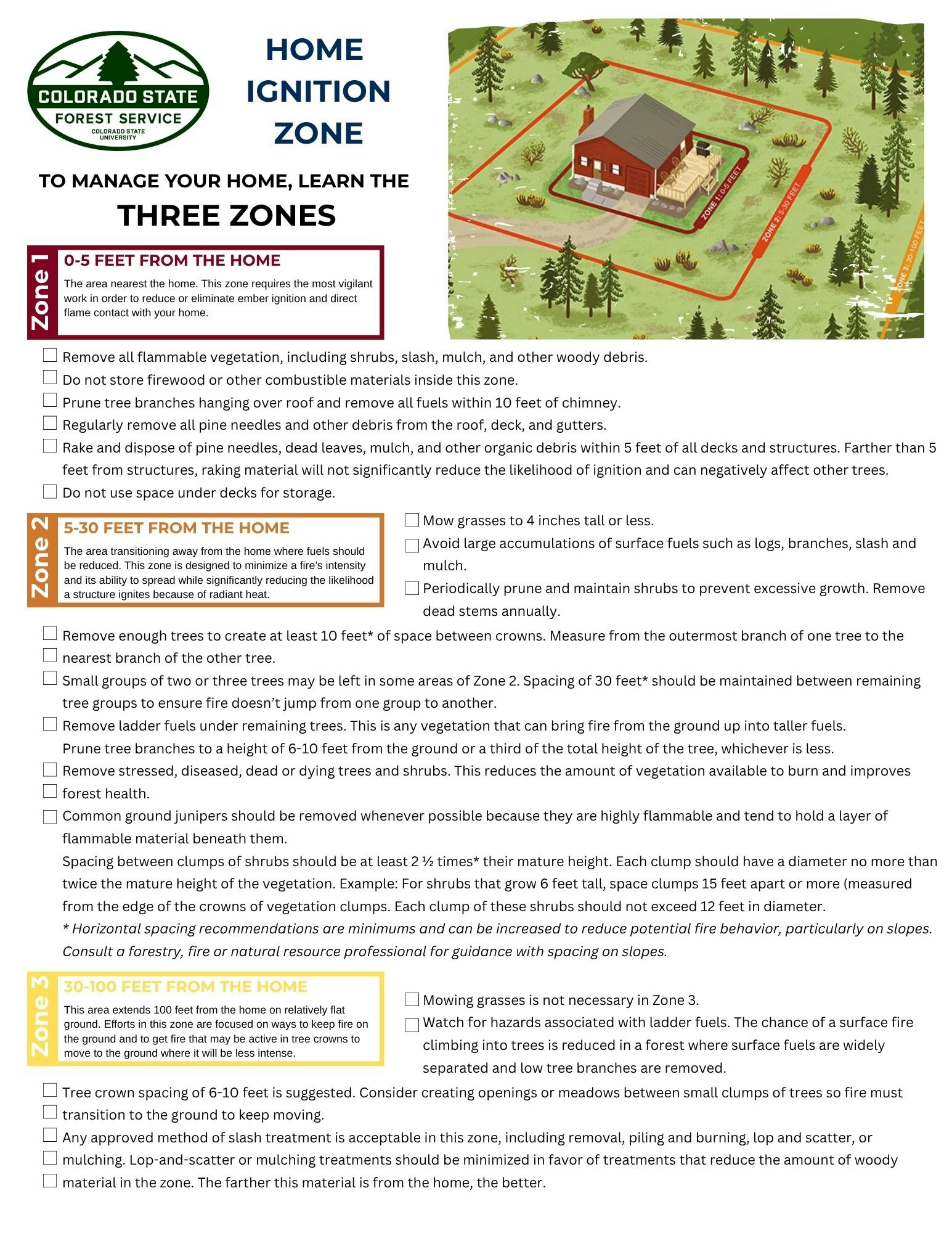
This involves establishing a series of management zones around each building on your property including homes, detached garages, storage buildings, barns, and other structures.
What is Structural Ignitability?
the likelihood the materials in and on your home will ignite during a wildfire. The practice of reducing structural ignitability is commonly called "Home Hardening".
Best practices to reduce structural ignitability:
- Ensure the roof has a Class A fire rating.
- Remove all leaves, needles and other debris from decks, roofs, and gutters.
- Screen attic, roof, eaves and foundation vents with 1/8-inch metal mesh.
- Screen or wall-in stilt foundations and decks with 1/8-inch metal mesh.
- Use tempered glass for windows; two or more panes are recommended.
- Create 6 inches of vertical clearance between the ground and home siding.
- Replace combustible fencing or gates, at least within 5 feet of the home.
Best practices for creating effective defensible space:
- Mow grass and weeds to a height of 4 inches or less (as needed).
- Rake and remove all pine needles and other flammable debris from a 5-foot radius around the foundation of your home and deck (as needed).
- Treat or mow shrubs that re-sprout aggressively (such as Gambel oak) every 3-5 years or more depending on growth rates.
- Remove branches that hang over the roof and chimney.
- Dispose of slash from thinning trees and shrubs by chipping, hauling to a disposal site or piling in open areas for burning later. Any accumulation of slash that’s chipped or otherwise should be isolated 30 feet or more from the home (as needed).
- Avoid creating continuous areas of wood chips on the ground when chipping logs and/or slash. Break up the layer of wood chips by adding nonflammable material, or allow for wide gaps of at least 3 feet between chip accumulations.

Visit South Metro's page on Preparing for Wildfires for more information.
LOW-FLAMMABILITY LANDSCAPING
When planning your landscaping, keep in mind that some plants and trees are more flammable than others. The Colorado State Forest Service and Colorado State University identify junipers as common flammable trees. Junipers are not recommended close to your home.
The recommendations on the plant list in the Low-Flammability Plants were based on the methodology developed by Idaho Firewise in Boise, Idaho. Plants are ranked on the scale from 0-10. Zero is the most flammable and 10 is least flammable. For zones 1 and 2 which are closer to the house, we recommend only plants rated 8, 9 and 10.

Colorado State University has provided a Low-Flammability Fact Sheet and List for Zones 1 and 2 of your Home Ignition Zone (0-30 feet around your structures).
Click the graphic below to learn more.

COLORADO WILDFIRE RESILIENCY CODE
What is the Colorado Wildfire Resiliency Code?
The Colorado Wildfire Resiliency Code is a statewide code designed to reduce the risk of homes and other structures being damaged or destroyed by wildfire.
Importantly, the code does not automatically require every existing homeowner in Colorado to modify their property. It applies primarily to new construction and certain qualifying improvements or development within areas identified as being in the Wildland-Urban Interface (WUI), with applicability based on the state’s wildfire risk mapping and the requirements implemented by the local jurisdiction. Existing homes generally are not required to be retrofitted simply because they are located in the WUI. The Colorado Division of Fire Prevention and Control supports the state’s Wildfire Resiliency Code Board, which oversees this framework.
Who is responsible for enforcing the Colorado Wildfire Resiliency Code in areas served by South Metro Fire Rescue?
South Metro Fire Rescue has formally adopted the Colorado Wildfire Resiliency Code; however, we are not currently administering or enforcing the code within our district, as it is currently being managed by our local partner jurisdictions that have adopted it.
SMFR continues to support these partners and our community with wildfire mitigation efforts.
What does the CO Wildfire Resiliency code have to say about fencing?
- 502.4.1 Fencing. Fencing within 8 feet of a structure regulated by this code or up to the property line when the property line is less than 8 feet away from the structure shall be constructed with noncombustible or ignition-resistant materials.Exception: Vinyl fencing. Vinyl fencing may be allowed.
You can find the entire Colorado Division of Fire Prevention and Control (DFPC) Wildfire Resiliency Code linked here. DFPC Wildfire Resiliency Code
ADDITIONAL WILDFIRE RESOURCES
The NFPA has also created a Wildfire Community Preparedness Toolkit for you and your neighborhood!
The Colorado Division of Insurance offers information to help people better understand how to navigate homeowners insurance in regards to wildfires. Review their toolkit to make sure you are fully protected should a wildfire destroy or damage your home. Homeowner Insurance Toolkit
Children often do not consider or grasp the potential danger to themselves or others regarding lighting fires. They may not understand how their misuse of fire can affect an entire community. If you are a concerned parent, educator, mental health professional, or community member, our resources are designed to identify, intervene, and educate children about the dangers and consequences of youth fire setting. Please visit our page on Youth Fire Setting for more information.
Visit www.SouthMetroCRR.org for more safety information on wildfires and more.

Reach out to the South Metro Community Risk Reduction Team with any questions you may have about Wildfire and Emergency Preparedness. We are here for you!